Educational MRI EDUMR20-010V-I
Brief Introduction:
- Magnet type: permanent magnet
- Magnetic field intensity: 0.5 ± 0.08 T
- Probe diameter: 10 mm
EDU20 can be used by physics lecturers to demonstrate NMR experiments and imaging professionals to teach courses, therefore enable students to gradually learn to master NMR/MRI technology through observation of a range of diverse sequences, different magnetic resonance signals, K spatial distribution for different settings, imaging parameters organization, and the impact of different levels of image contrast. Moreover, the accessible software and hardware architecture allow the functionality of the instrument to be extended and enhance the students’ capability. Combining teaching and research greatly enhances the professional capacity of the university for research while at the same time providing the community the same quality of training as magnetic resonance imaging professionals.
- Open hardware: Experiments based on continuous wave NMR apparatus can be imitated during experimental teaching, engineering training, and classroom demonstration. Hardware can be assembled and disassembled, and with the use of oscilloscope and multimeter, advance students’ practical ability and acquaint students with hardware structure of NMR device. Thus the system meets the demands of modern experimental teaching by building students’ practical ability.
- Open software: Simulation experiments of image processing including image re-construction, enhancement, filtering, etc. can be carried out by use of the open original K-space data. For majors whose directions are signal processing or data processing, accuracy and effective data can be provided for teachers and students to make further extensive studies such as algorithm optimization, imaging post-processing, etc.
The main modules are the same as used in medical MRI devices, providing a real-life experience of NMR principles, device and application.The EDUMR20-010V-I series products truly take the demands of teaching experiment into consideration. It is an experimental instrument developed to facilitate modern methods of education:
- Automatic search of duration of 90° pulse and 180° pulse; export of experimental results
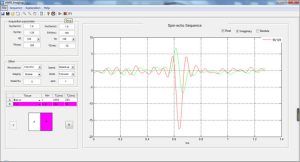
- NMR signal acquisition, data processing and export. Time-domain FID signal, frequency-domain FID signal, single SE signal and multiple SE signal are all visible in experiment processes.
- Display, processing and export of NMR images
- Provide K-space raw data
- Both automatic and manual correction of resonance frequency
- Open-tested system hardware
- Function of distance self-service experiment
- Various imaging sequences
- The powerful multi-exponent inversion and fitting software by which T1, T2 and T2* inversion and fitting can be carried out
- Expandable 3D imaging and reconstruction of image
- Dicom format data.
-
- The following teaching and experimental projects can be accomplished using the characteristics and functions of EDUMR20.
- In teaching experiments of corresponding medical engineering majors, EDUMR20, as an MRI technology experimental device, can be used to demonstrate NMR and MRI principles, such as :
Reasonable selection of pulse sequence;
Influence of parameters on image quality;
Reason of artifacts, trouble shooting of device, etc. - In large-scale medical device majors, EDU20 can be used to demonstrate the following:
NMR imaging,
Operation principle of inner structure of the device,
Factors affecting image quality, etc. - In biomedical engineering majors, EDU20 can be used to demonstrate:
MRI principle
Quality control and evaluation of NMR image, etc.
Extensive experiments can also be conducted to explore more applications in biological science. - In teaching experiments of relevant physical majors, EDU20 can be used to demonstrate:
Experiments based on continuous wave NMR apparatus;
NMR and MRI principles;
Furthermore, in physical and electron majors, studies of electron device (such as signal transmission and receiving by using electronic pulse), experiments of data processing or image reconstruction can be explored. Detailed user manual is integrated with EDU20 to help students accomplish experimental operation visually and clearly.
- In teaching experiments of corresponding medical engineering majors, EDUMR20, as an MRI technology experimental device, can be used to demonstrate NMR and MRI principles, such as :

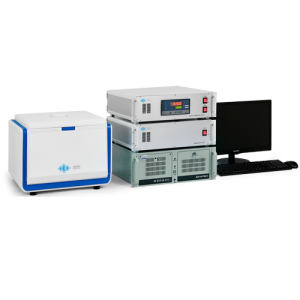
Portable Educational MRI System Training MRI Device
Brief Introduction:
- Model: MiniEDU20
- Application: NMR/MRI basic theory
- Magnet type: permanent magnet
Product Description:
MiniEDU20 MRI system is Niumag’s original product, first used as an integral part of other products. After nearly 10 years of enhancements, its design and functionality are comprehensive and mature. MiniEDU20 can be used by physics lecturers to demonstrate NMR experiments and imaging professionals to teach courses, so that multiple students gain experience in using MR technology without needing to operate expensive instruments.
Basic parameters:
- Magnet type: permanent magnet
- Magnetic field intensity: 0.5±0.08T
- Probe coil: Ø10mm
- Weight: 49.8Kg
Applications:
- NMR/MRI basic theory (Physics)
- MRI system (Electronic information engineering)
- NMR/MRI theoretic experiments
- MR Imaging technical experiments
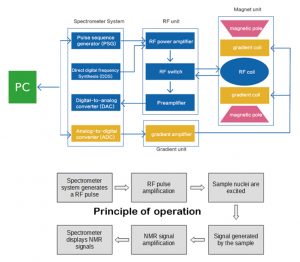
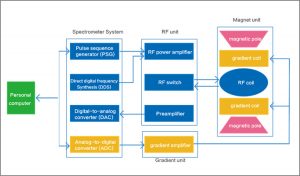
MRI System Framework:
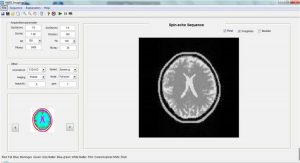
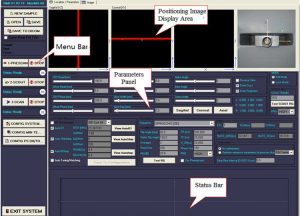
MRI Software:
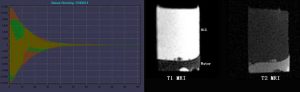
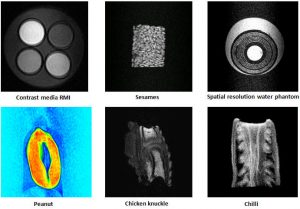
NMR Signal and Weighted MR Imaging:
EduMR Education MRI Device Teaching NMR System,MRI Training
Brief Introduction:
- Model: EDUMR
- Application: NMR & MRI Teaching
- Optional: Small Animal MRI
- Magnet type: permanent magnet
- Magnetic field intensity: 0.5±0.08T
- Probe coil: Ø15mm
- Weight: 138Kg
Applications:
- Basic NMR analyzing and imaging mechanism
- NMR phenomenon
- Relaxation and NMR signal
- Spatial orientation of NMR signal
- NMR image reconstruction
- Pulse sequence
- Magnet body system
- RF(radio frequency) system
- Gradient field system
- Spectrometer and computer system
- Magnetic shielding and RF shielding
- Pulse sequence
- Mechanical and electronic shimming
- Lamor frequency measurement by hard pulse FID sequence
- FID sequence signal in rotating coordination system
- 1D-processing and gain adjustment of FID signal
- Hard pulse RF measurement with hard pulse echo sequence
- Soft pulse RF measurement with soft pulse FID sequence
- Soft pulse echo sequence
- T1 relaxation time measurement using inversion restoring method
- T1 relaxation time measurement using saturation restoring method
- T2 relaxation time measurement using hard pulse CPMG sequence
- Chemical shift measurement of alcohol
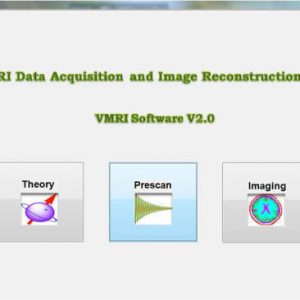
EduVMR Virtual Educational MRI System Training NMR Software
Brief Introduction:
- Model: EDUVMR
- Application: Virtual NMR/MRI System
- Optional: EDUMRI
VMRI minimized the need for hardware to effect NMR experiment effect, overcoming the limitations of high hardware demands, long sampling time in actual tests, and insufficient number of the instrument.
VMRI includes three parts: Theory, Prescan and Imaging. The teaching experiments that are possible include: measuring the Larmor Frequency, hard RF pulse determined, electronic shimming, kinds of weighted image and half Fourier scanning technology etc..
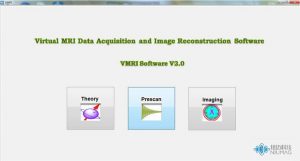
- Virtual achieve sequence selection, parameter adjustment, data acquisition, K space filling, image reconstruction
- Virtual Electronic Noise and Inhomogeneity Effects on Image
- Virtual different MRI technology to sample
- Supporting 16 NMR&MRI Experimental Projects
Advantages:
- Avoiding long sampling time in actual test
- Avoiding high requirement with hardware
- Avoiding gradient vortex
- Greatly reduce equipment costs while meeting the teaching needs